
Choosing among the top 10 swimming suit suppliers is not simply a price comparison. Buyers also need to examine fabric quality, stitching, sizing consistency, production capacity, and communication. A sample may look polished under studio lights. The real test comes after repeated wear, washing, and exposure to sun and pool water.
Swimwear designer Norma Kamali has said, “The bathing suit is the most important thing you buy.” That thought helps explain why supplier selection deserves care. A dependable partner should provide clear material details, realistic lead times, and samples that match production quality. Small details matter: a lining that stays flat, seams that do not rub, and colors that remain consistent across sizes. Ask direct questions. Check the answers.
This guide compares ten swimming suit suppliers through practical sourcing considerations, including product range, customization, quality controls, and suitability for different order sizes. No ranking can fit every business. A boutique label and a large retailer may need very different partners. Supplier information can also change, so readers should confirm current terms and request recent samples before placing orders. We may still miss something; published claims do not replace hands-on testing. Use the list as a starting point, then compare each supplier against your product brief, budget, and customers’ needs.
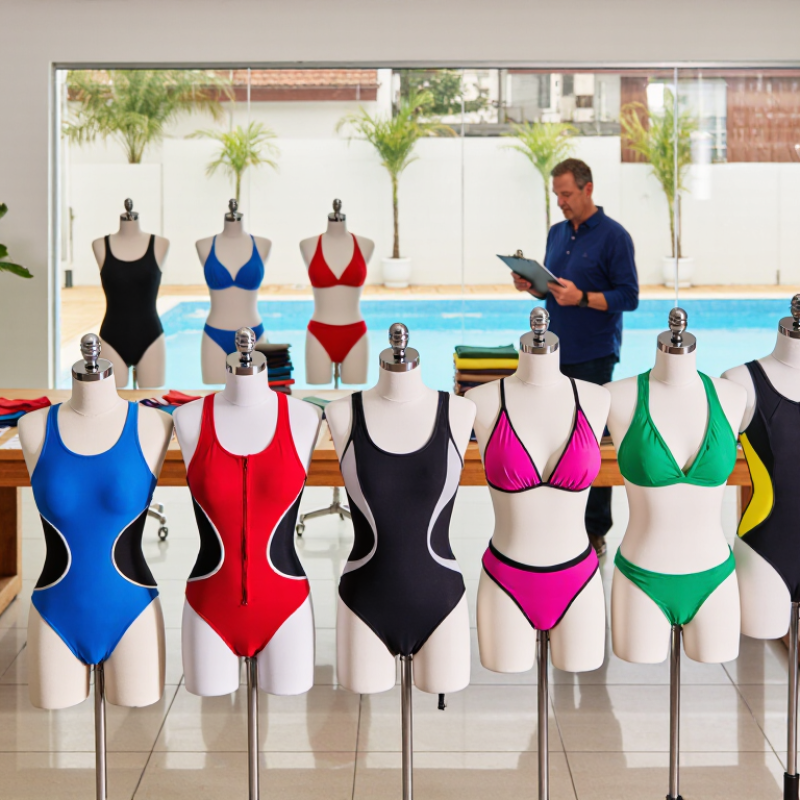
Swimming suit suppliers can provide fabric selection, garment development, and production support. Common options include chlorine-resistant polyester, stretch nylon, and lining fabrics with different weights. A supplier may recommend a blend, but the best choice depends on the suit’s intended use. Pool training, beachwear, and competition each place different demands on stretch, coverage, and durability.
Many suppliers also help turn a sketch into a production-ready design. Services may include pattern making, size grading, sample sewing, color matching, and adjustments to straps or leg openings. A sample lets buyers check details such as seam placement, lining opacity, and how elastic feels when wet. Small details matter. Some suppliers provide labels, packaging, and shipment coordination, while others focus mainly on sewing. Ask which tasks are handled in-house and which are outsourced.
Quality checks may cover measurements, stitching, fabric shade, and finished-garment appearance. Buyers can request written specifications and agree on acceptable tolerances before bulk production. I would not treat one polished sample as proof of consistent production; that assumption is easy to make. Fit is personal. Clear size charts, documented revisions, and repeat checks help reduce surprises, though they cannot remove every variation between batches.
A dependable swimming suit supplier should show more than attractive product photos. Ask for fabric composition, stretch recovery, colorfastness, and chlorine-resistance details. These affect how suits feel and look after repeated pool use. Request a sample in the exact fabric and construction you plan to order. Check seams, lining, elastic, and size consistency by hand. Small details matter.
Tips: Wash and stretch samples several times. Ask for proof of test methods, not just broad claims. Compare the finished sample with the production specification.
Review the supplier’s capacity, lead times, minimum order quantities, and quality-control process. Clear answers help you plan around seasonal demand. Ask how defects are recorded and resolved, and whether inspection reports are available. Communication matters, too. A supplier who flags delays early is easier to work with than one who simply promises fast delivery. It is easy to focus on price and overlook fit consistency; that gap can become costly when sizes vary between batches. No checklist removes every risk, so keep written specifications and approve a pre-production sample before confirming a larger order.
These ten profiles describe supplier capabilities, not a verified sales ranking; production claims and lead times need checking. Grand View Research valued the global swimwear market at USD 23.1 billion in 2023 and forecast 4.5% annual growth through 2030. The outlook makes fabric expertise important. An integrated mill controls knitting and dyeing; a recycled-yarn specialist offers material options; a performance-fabric supplier tests chlorine and saltwater resistance. A fashion-focused OEM develops seasonal prints, while a private-label maker manages patterns, labels, and packaging. Small details count.
Other profiles serve different buying needs. A low-minimum supplier suits test orders, though unit costs may rise. A technical maker specializes in compression and secure seams. A children’s swimwear producer focuses on soft linings and durable stitching. A traceability-focused supplier documents fiber origins, while a regional factory may shorten shipping times. Textile Exchange’s Materials Market Report 2024 estimates global fiber production reached 124 million tonnes in 2023, with polyester representing 57%. That scale matters, but recycled content alone does not prove lower impact. Ask for test results, sample approval records, and clear production timelines. I would still inspect stitching after repeated washing; paperwork cannot reveal every weak seam.
Estimated global swimwear market revenue, 2023–2030 (USD billions)
The 2023 market value is reported by Grand View Research. Values for 2024–2030 are calculated estimates using its reported 6.8% compound annual growth rate; they are not supplier-specific sales figures. Source: Grand View Research.
Swimming suit suppliers vary in product depth, production scale, and the markets they serve. Some concentrate on competitive swimwear, with chlorine-resistant fabric, secure seams, and streamlined cuts. Others offer resort styles, children’s suits, plus-size ranges, or coordinated cover-ups. A broad catalog can look impressive, but it may hide limited expertise in technical fabrics. Small detail: check the lining.
Compare capabilities through specific questions. Can the supplier develop a sample from a measurement chart? Can it maintain consistent sizing across repeat orders? Ask about fabric sourcing, colorfastness testing, seam construction, minimum order quantities, and realistic lead times. A sample should be checked after stretching and washing, not just admired on a hanger. That takes time. Suppliers serving large retail markets may offer higher volume and more established quality checks; smaller regional producers may provide closer communication and lower order thresholds. Neither model is automatically better. Price alone rarely reveals how reliably a supplier can reproduce a suit’s fit, color, and finish. One practical weakness in many comparisons is relying on catalog photos; actual samples often tell a less polished, more useful story.
Choosing a swimming suit supplier starts with the fabric, not the catalogue. Textile Exchange’s Materials Market Report 2024 estimates global fibre production reached 124 million tonnes in 2023, with polyester accounting for 57%. That scale makes traceability worth checking. Ask for fibre composition, recycled-content documentation, and the mill’s name. Request lab evidence for chlorinated-water colourfastness, such as testing aligned with ISO 105-E03, plus stretch recovery and seam strength. Ask to see results for the actual fabric lot, not a generic sheet. Small difference; important.
Compare samples and production controls. Wear-test a sample, then check lining opacity, elastic comfort, and whether straps twist after repeated pulls. Test it wet. Ask how the supplier records shade variation, needle breaks, and final measurements. Clarify minimum order quantity, sample fees, production lead time, and who pays if a batch misses agreed specifications. Get each point in writing. A low unit price can hide costly rework. Verify capacity with a pilot order, then compare delivered quality against your approved sample. One caveat: a polished sample cannot prove bulk consistency. Agree on inspection criteria before paying a deposit.
The entries below describe common supplier types, not named companies or a verified company ranking. Minimum order quantities and lead times are indicative industry ranges; actual terms vary by fabric availability, design complexity, order size, and season.
| No. | Supplier Profile | Typical Production Model | Indicative MOQ | Typical Sample / Bulk Lead Time | Best Fit | Key Checks Before Ordering |
|---|---|---|---|---|---|---|
| 1 | Swimwear specialist manufacturer | OEM and custom production focused on swimwear construction | About 100–500 pieces per style or color | Samples: 2–4 weeks; bulk: 6–10 weeks | Brands needing fit development, lining, elastic, and swim-specific sewing expertise | Request fit samples, seam and lining specifications, fabric test reports, and production references |
| 2 | Private-label swimwear producer | Ready-made blocks customized with labels, colors, and selected details | About 50–300 pieces per style, depending on customization | Samples: 1–3 weeks; bulk: 4–8 weeks | New or small brands seeking a faster route to market | Confirm which design elements are customizable and whether fabric colors require a minimum dye lot |
| 3 | Full-package OEM supplier | May coordinate fabric sourcing, pattern development, cutting, sewing, and packing | About 200–1,000 pieces per style | Samples: 3–5 weeks; bulk: 8–12 weeks | Buyers wanting one production partner for several manufacturing steps | Clarify material ownership, approval stages, testing responsibility, and what is included in the quote |
| 4 | Design-and-development ODM supplier | Supplies existing or adapted designs; may offer pattern and product development | About 100–500 pieces per design | Samples: 2–5 weeks; bulk: 6–10 weeks | Businesses needing design support or a collection based on established silhouettes | Check design ownership, exclusivity terms, size grading, and availability of development staff |
| 5 | Performance and competition swimwear producer | Technical production using performance fabrics and close-fitting construction | About 100–500 pieces per style; technical fabric choices may raise minimums | Samples: 3–6 weeks; bulk: 8–14 weeks | Training, team, and performance-oriented collections | Verify fabric composition, stretch and recovery, chlorine-resistance claims, and applicable testing evidence |
| 6 | Recycled-fabric swimwear supplier | Uses recycled-content textiles when available, with custom or private-label production | About 200–1,000 pieces per style, depending on mill minimums | Samples: 3–6 weeks; bulk: 8–14 weeks | Collections requiring documented recycled-material sourcing | Request current transaction or scope certificates where applicable, and confirm fabric composition and traceability |
| 7 | Small-batch and boutique workshop | Short-run cut-and-sew, often with limited material and color choices | About 20–150 pieces per style | Samples: 2–4 weeks; bulk: 4–8 weeks | Market tests, limited collections, and smaller initial orders | Check repeat-order capacity, size consistency, fabric sourcing continuity, and per-unit cost at scale |
| 8 | Large-volume apparel factory with swimwear lines | High-volume production with established cutting, sewing, and quality-control systems | About 500–2,000+ pieces per style or color | Samples: 3–6 weeks; bulk: 10–16 weeks | Established buyers placing large, repeatable orders | Confirm dedicated swimwear capacity, order scheduling, subcontracting policy, and inspection procedures |
| 9 | Regional sourcing and production partner | Coordinates local factories, materials, sampling, and export preparation | Often about 100–500 pieces per style, subject to factory terms | Samples: 2–5 weeks; bulk: 7–13 weeks | Buyers who value local communication, regional logistics, or consolidated sourcing | Identify the actual factory, clarify service fees, and verify who controls quality and delivery commitments |
| 10 | Stock-program and ready-to-ship supplier | Sells available styles from existing inventory, sometimes with simple label or packaging changes | May start from 1–50 pieces per style if stock is available | Samples: several days to 2 weeks; dispatch: typically 1–4 weeks | Fast launches, small test orders, and replenishment from available stock | Check live inventory, size and color availability, reorder consistency, and the return policy |