

What Are the Top 10 Types of Mens Watches?

Choosing the right Mens Watches category is harder than a glossy display suggests. A polished dress watch may look perfect under office lights, yet feel fragile during a weekend hike. A dive watch may survive rain and knocks, but seem bulky beneath a shirt cuff. This guide examines ten major types through practical use, design history, movement technology, and daily comfort. The selection includes dress watches, dive watches, field watches, pilot watches, chronographs, GMT watches, racing watches, digital watches, smartwatches, and skeleton watches. Each type serves a different lifestyle, budget, and personal taste.

Renowned British watchmaker George Daniels described a watch as “a small machine that tells the time.” His words remain useful because they return attention to function. However, modern Mens Watches often communicate identity as strongly as time. Case size, water resistance, strap material, legibility, accuracy, and service requirements all deserve close inspection. A mechanical chronograph can feel like a tiny engine beneath the crystal. A field watch can disappear comfortably beneath a wool sleeve. A smartwatch can quietly track a morning run.

No list is perfectly objective. That is worth admitting. Some categories overlap, and manufacturers often blend their features. A GMT watch may borrow a pilot’s dial, while a racing watch may use a chronograph movement. The aim is not to crown one universal winner. It is to clarify what each watch does well, where it disappoints, and who will genuinely enjoy wearing it.
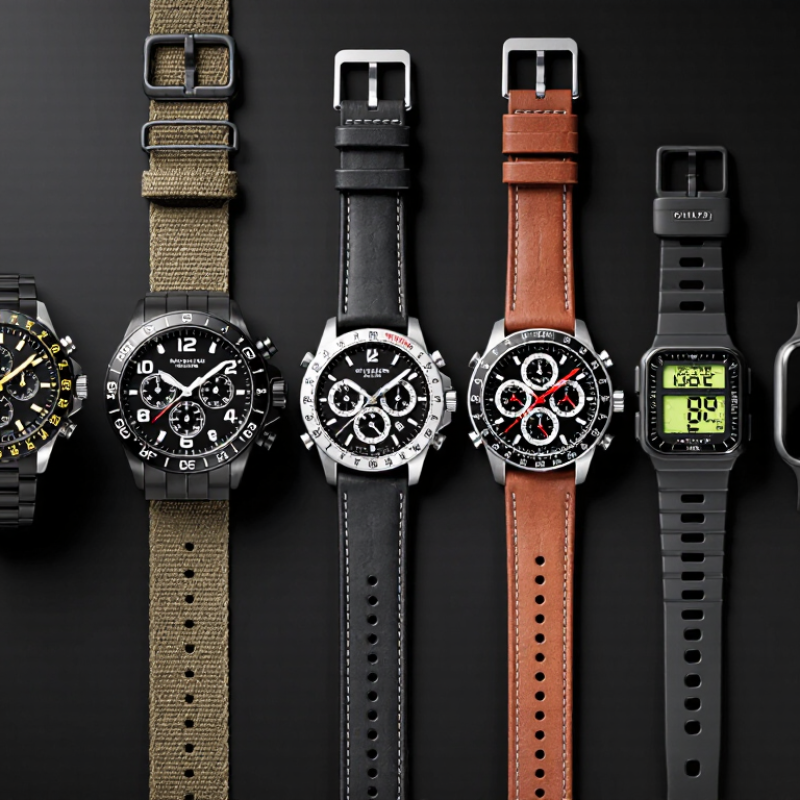
What Are the Top 10 Types of Mens Watches?

How Men’s Watches Are Classified by Purpose, Design, and Movement

What Are the Top 10 Types of Mens Watches?

Men’s watches are best classified by purpose, design, and movement.

A dress watch uses a slim case, clean dial, and restrained details. It suits formal clothing and quiet office settings.

A field watch favors strong legibility, simple numerals, and practical durability.

A dive watch usually has high water resistance, luminous markers, and a rotating timing bezel.

A pilot watch emphasizes quick reading, often with large hands and clear contrasts.

A racing watch commonly includes a chronograph for measuring short time intervals.

A GMT watch displays another time zone, making it useful for frequent travelers.

A digital watch shows time electronically and often adds alarms, timers, or calendars.

A smartwatch combines timekeeping with notifications, health measurements, and phone connectivity.

A skeleton watch exposes parts of its movement through cutout sections, making mechanics part of the design.

A chronograph can also stand alone as a tenth category, especially when its stopwatch function matters more than its racing appearance.

Movement adds another layer.

Mechanical watches store energy in a spring, while automatic models wind through wrist motion.

Quartz movements use electronic regulation and usually offer strong daily accuracy.

Solar watches convert light into stored energy, reducing battery changes.

These categories overlap. A dive watch may use quartz or automatic power, and a pilot watch may include GMT functions.

The system is useful, but not perfect. Personal comfort and real habits still matter more than labels.

A beautiful watch can remain unworn.

That is worth remembering.

Dress and Field Watches: Formal Style and Everyday Readability

Among the top 10 types of men’s watches, dress and field watches solve very different style needs. A dress watch uses a slim case, clean dial, and restrained details. It sits neatly beneath a shirt cuff. Field watches favor strong legibility, practical numerals, and sturdy construction. Their clear hands remain useful in poor light or during outdoor work.

In my experience, case size matters more than many buyers expect. A 36–40 mm dress watch often looks balanced with formal clothing. A field watch may suit a slightly larger case, especially with a textured strap. Choose a readable dial before decorative features. Water resistance also deserves attention, even for daily wear. Specifications help, but comfort decides whether the watch leaves your wrist. The perfect choice is rarely perfect.

A dress watch can soften a dark suit, while a field watch adds relaxed character to denim, cotton, or workwear. Leather feels traditional, but fabric or rubber may handle heat better. I once selected a beautiful watch with poor nighttime visibility. It looked impressive, yet daily use exposed its weakness. That mistake still influences my recommendations.

Tips: Match the watch to your routine, not only your wardrobe. Check the lug width and strap quality before buying. Try reading the dial from arm’s length. Keep the design simple if you want long-term versatility.

Dive and Pilot Watches: Professional Features for Land and Sea

Among the ten major men’s watch types, dive and pilot watches stand apart through purpose-built design. A dive watch typically uses high water resistance, a screw-down crown, luminous markers, and a rotating timing bezel. These features help track a descent or safety interval underwater. A strong case and secure strap matter when gloves, saltwater, and pressure create problems. ISO-style testing can indicate serious performance, but certification alone does not guarantee careful maintenance. Seals age. Crowns loosen. I would check gaskets before every demanding trip, though many owners probably inspect them too rarely.

Pilot watches serve a different environment. Their large numerals, clear minute tracks, and strong contrast support quick reading in a vibrating cockpit. Some include a twelve-hour bezel, slide-rule scale, or second time zone. These tools help only when the wearer understands them. Decoration can look professional while adding little value. Accurate quartz and mechanical movements can both serve pilots, depending on power needs and tolerance for adjustment. Magnetic exposure, temperature changes, and poor visibility remain practical concerns. A soft leather strap may feel comfortable, but it performs poorly around water. I prefer a legible dial over oversized styling. Bigger is not always clearer. Before buying, compare actual lume, crown grip, bezel action, and service access. Hands-on testing in dim rooms often reveals flaws that photographs hide.

What Are the Top 10 Types of Men's Watches? — Dive and Pilot Watches: Professional Features for Land and Sea

Watch Type Primary Use Typical Water Resistance Professional Features Dial and Legibility Bezel or Timing System Common Movement
Dive Watch Scuba diving, swimming, boating, and water sports 100–300 m Screw-down crown, strong case construction, luminous hands and markers, and a secure strap or bracelet High-contrast markers with strong lume for low-light underwater reading Unidirectional rotating bezel for tracking elapsed dive time and limiting accidental overestimation Automatic or quartz
Pilot or Aviator Watch Flight operations, navigation, and aviation-inspired everyday wear 30–100 m Highly readable layout, precise time setting, large crown, and sometimes a second-time-zone function Large Arabic numerals, clear minute track, and high contrast between hands and dial Fixed timing bezel or rotating slide-rule bezel on specialized designs Mechanical, automatic, or quartz
Field Watch Hiking, camping, outdoor work, and casual daily use 50–100 m Durable case, reliable timekeeping, compact profile, and easy-to-read 12-hour and 24-hour scales Simple numerals, minute markers, and luminous hands for quick reading Usually no bezel; elapsed-time measurement is not its primary purpose Hand-wound, automatic, or quartz
Dress Watch Formal occasions, business attire, and understated daily wear 30–50 m Slim case, refined finishing, comfortable leather or metal strap, and restrained design Minimal indices, thin hands, and a clean dial with limited complications Fixed bezel, generally without a timing scale Mechanical, automatic, or quartz
Chronograph Watch Short-interval timing, sport, work, and motorsport activities 50–100 m Independent stopwatch mechanism, pushers, elapsed-time scales, and subdials Multiple subdials display seconds, minutes, or hours measured by the chronograph Fixed or tachymeter bezel on some models; pushers control the stopwatch Quartz or mechanical
GMT Watch Travel, international business, and monitoring a second time zone 50–100 m Independent 24-hour hand, dual-time display, and quick adjustment for travel in some movements Additional 24-hour scale paired with a fourth hand or digital display Fixed or rotating 24-hour bezel for reading a second time zone Automatic, mechanical, or quartz
Racing Watch Motorsport timing, driving, and sporty casual wear 50–100 m Fast elapsed-time reading, stopwatch operation, durable case, and strong strap security Bold indices, contrasting subdials, and clear minute or seconds markings Tachymeter scale or chronograph system for calculating speed over a measured distance Quartz or mechanical chronograph
Military-Style Watch Rugged outdoor use, field activities, and practical daily wear 50–200 m Shock-resistant construction, subdued finishes, luminous markings, and dependable operation High-contrast dial with clear 12-hour and 24-hour indications Usually a fixed bezel or a simple timing bezel Quartz, automatic, or hand-wound
Smartwatch Fitness tracking, notifications, navigation, and connected daily use Commonly 30–50 m Activity sensors, heart-rate monitoring, GPS on many models, alarms, and digital connectivity Configurable digital display with adjustable brightness and multiple data screens Touch controls, digital timers, and software-based measurement tools Rechargeable electronic module
Digital Sports Watch Training, outdoor recreation, travel, and everyday timing 50–200 m Shock resistance, stopwatch, countdown timer, alarm, backlight, and sometimes a barometer or compass Large digital numerals designed for quick reading during movement Electronic timing functions controlled by dedicated pushers Quartz or electronic module

Racing and Military Watches: Precision, Durability, and Function

Racing and military watches show why men’s watches are more than decorative accessories. Racing models prioritize elapsed-time measurement, clear sub-dials, and quick pusher control. A chronograph can track a lap, a parking interval, or a short task. Some include a tachymeter scale for estimating speed over a known distance. High-contrast hands remain useful when sunlight reflects across the crystal. However, crowded dials can slow reading. More features do not always mean better function.

Military watches focus on dependable legibility under pressure. Matte cases help reduce glare, while strong lume supports reading in darkness. Fixed spring bars, protected crowns, and shock-resistant movements improve daily resilience. Water resistance matters, but its rating is not a promise of unlimited safety. Seals age, and careless crown handling can still cause damage. My practical preference is simple: test the watch during ordinary routines, not only during purchase. That reveals weaknesses.

Tips: Choose a racing watch for timing tasks and active driving environments. Choose a military-style watch for quiet readability and rough daily use. Check the case thickness before buying; a bulky case may catch on clothing. Inspect the strap, clasp, and crystal regularly. Keep records of servicing, especially after strong impacts or water exposure. A watch can be tough. It is never invincible.

What Are the Top 10 Types of Men’s Watches?

Racing and Military Watches: Precision, Durability, and Function

This comparative index scores each watch type from 1 to 10 across three practical criteria: timing precision, resistance to demanding conditions, and everyday or specialist functionality. Racing watches emphasize chronograph timing and readability, while military and field watches prioritize durability, legibility, and dependable operation. Scores represent typical category characteristics rather than any specific company or brand.

Chronographs, GMTs, Smartwatches, and Digital Watches Compared

Men’s watches are easier to compare when function leads design. The ten major types include dress, field, dive, pilot, racing, chronograph, GMT, moonphase, smartwatch, and digital watches. A dress watch usually slips beneath a shirt cuff, while a field watch favors clear numerals and sturdy cases. Dive watches use rotating bezels for elapsed time. Pilot watches emphasize high contrast. Racing watches often add a chronograph, which measures short intervals through pushers and subdials.

A chronograph suits track-day timing, but its busy dial can slow daily reading. A GMT adds a second time zone, useful for flights or remote work. Moonphase models display lunar cycles, though the feature is mainly decorative. Smartwatches combine notifications, heart-rate tracking, navigation, and workout records.

IDC’s Worldwide Quarterly Wearable Device Tracker reported more than 500 million wearable-device shipments in 2024, showing strong demand for connected formats. Digital watches remain practical because LCD displays deliver quick readings, alarms, timers, and low maintenance. They are often underestimated.

Mechanical movements still attract buyers who value tactile winding and visible craftsmanship. The Federation of the Swiss Watch Industry reported Swiss watch exports of about CHF 26 billion in 2024, despite a year-on-year decline. That contrast matters: traditional watches retain economic weight, while connected watches expand everyday utility.

In my experience, water resistance ratings are frequently misunderstood. A stated 50 metres does not automatically mean safe diving. Case thickness, strap comfort, battery life, and service access may matter more than a complicated dial. The “best” type can change by Tuesday.

Article Source:

Go to Top